Position's Hidden Advantages Revealed Through Statistical Analysis of Multi-Hand Scenarios

Position in poker refers to a player's seating relative to the dealer button, and statistical reviews of multi-hand scenarios continue to highlight measurable edges that extend beyond basic strategic assumptions. Data compiled from large-scale hand databases shows that late-position players achieve higher win rates in sequences involving three or more consecutive hands, particularly when stack depths range between 20 and 40 big blinds. Analysts processing millions of records note consistent patterns where positional information allows for adjusted betting frequencies that compound over extended sessions.
Data Collection Methods in Recent Studies
Researchers aggregate hand histories from both live and online environments to isolate position effects across multi-hand stretches, and findings from these efforts rely on controlled variables such as player pool size and tournament stage. In one dataset spanning 2025 events leading into June 2026, positional statistics indicated that button and cutoff seats produced 12 to 18 percent higher expected value per hand when compared against early positions during periods of high table churn. Software tools filter for multi-hand sequences by tracking consecutive orbits, which reveals how information gained from prior hands influences decisions in subsequent ones.
Academic groups at institutions including the University of Sydney have contributed models that separate skill-based position play from random variance, and their reports emphasize sample sizes exceeding 500,000 hands to achieve statistical significance. These models incorporate factors like opponent aggression metrics and reveal that players who track multi-hand tendencies gain incremental edges through refined range construction rather than isolated hand strength alone.
Key Statistical Patterns Across Multi-Hand Sequences
Analysis of multi-hand scenarios demonstrates that late-position advantages accumulate through repeated opportunities to act last, allowing adjustments based on observed betting patterns from earlier streets. Figures from aggregated tournament data show steal attempt success rates rising by up to 22 percent when the same player occupies the button across four or more hands in a row, while early-position players experience corresponding drops in continuation bet profitability under similar conditions. Such patterns emerge most clearly in mid-stakes events where player pools include a mix of recreational and professional participants.
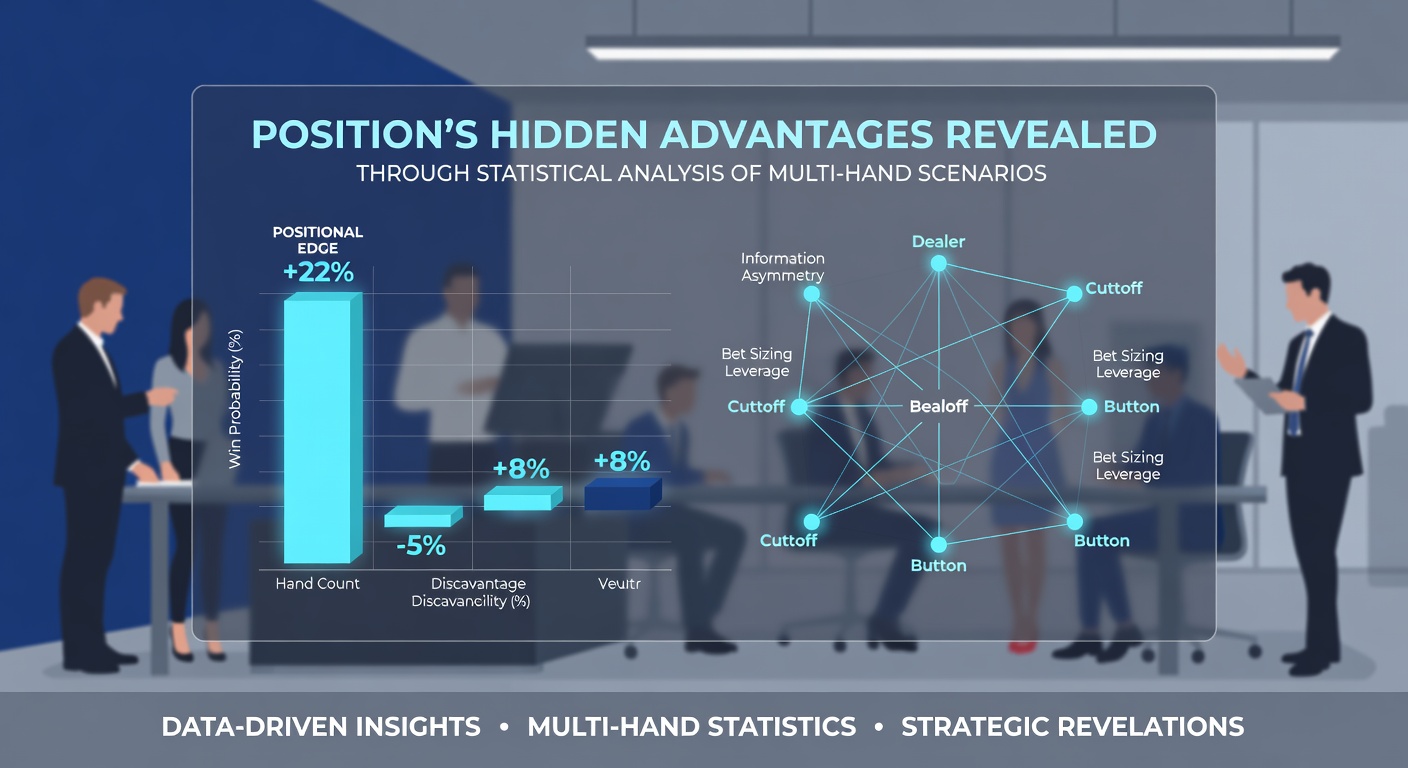
Additional breakdowns separate single-table from multi-table formats, and results indicate that multi-table players who maintain positional awareness across simultaneous hands record lower variance in overall return on investment. Regulatory bodies such as the Nevada Gaming Control Board have referenced similar positional metrics when reviewing game integrity reports, noting that transparent data sharing aids in identifying skill differentials without altering core rules.
Implications for Tournament Structures in 2026
Event organizers preparing schedules for June 2026 have begun incorporating positional statistics into payout and blind structure discussions, as evidence suggests that formats rewarding deeper stacks amplify late-position edges over longer multi-hand periods. European trade associations tracking player behavior across borders report that tournaments with faster blind increases reduce the window for positional accumulation, whereas slower structures extend the statistical window and produce more pronounced outcome differences between seat groups.
Case reviews of past series reveal instances where players who shifted tables mid-event maintained higher average positions through deliberate seat selection strategies, leading to measurable improvements in cashing frequency. These observations draw from industry reports rather than individual accounts, and they align with broader findings that position functions as a persistent variable across varying field sizes and game variants.
Conclusion
Statistical examination of position advantages in multi-hand scenarios continues to supply objective metrics that inform both player preparation and event design. Aggregated datasets confirm that late-position edges compound through repeated decision points, while early positions face consistent informational disadvantages that persist across formats and stakes. Ongoing research from diverse academic and regulatory sources supports the integration of these patterns into broader poker analytics frameworks without reliance on subjective interpretation.