Freeroll Fireworks: How No-Cost Entries Spark Real Bankroll Growth in Hold'em Events
Freeroll Fireworks: How No-Cost Entries Spark Real Bankroll Growth in Hold'em Events
Decoding the Freeroll Phenomenon in Hold'em
Freerolls stand out as tournaments where players enter without paying buy-ins, yet compete for cash prizes funded by poker sites or sponsors; these events draw thousands weekly, especially in No-Limit Texas Hold'em, because they offer a zero-risk gateway into competitive play. Data from major platforms reveals that freeroll prize pools often reach tens of thousands of dollars, with top finishers pocketing real money that jumpstarts bankrolls. Observers note how participants leverage these no-cost opportunities to build funds gradually, turning free entries into entry fees for higher-stakes games.
But here's the thing: while entry remains free, the fields swell massive—sometimes 10,000-strong—making survival a grind of patience and skill; still, consistent performers cash out enough to fund satellites or low-buy-in events, creating a snowball effect on bankrolls. Research indicates that players who treat freerolls seriously convert winnings into sustainable growth, with some scaling from zero to five figures over months.
How Freerolls Operate Within Hold'em Structures
In Hold'em freerolls, blinds escalate predictably—starting at 10/20 and climbing every 10-15 minutes—while stacks begin deep at 10,000-50,000 chips, allowing room for post-flop maneuvering; sites like PokerStars host daily events with such setups, where players fold relentlessly early on to preserve stacks amid hyper-aggression from recreational entrants. Turns out, the late stages condense into bubble play, where prize jumps motivate tight strategies, and final tables erupt with all-ins that decide winners.
What's interesting lies in the payout structures: top 10% often cash, but real value emerges for top 100 finishers who snag $50-$500 prizes; according to figures from PokerNews, average first-place payouts in major Hold'em freerolls hit $1,000 or more, providing seed capital that players roll into $5-$10 buy-ins next. And since these run 24/7 across time zones, global participation spikes, blending pros grinding volume with newcomers testing waters.
Mechanisms Driving Bankroll Expansion
Successful entrants deposit freeroll winnings directly into accounts, then enter micro-stakes cash games or satellites; one pathway shows a $100 freeroll score funding a $1 satellite that wins a $10K guaranteed seat, amplifying growth exponentially while risk stays minimal. Experts have observed patterns where disciplined players cap freeroll volume at 5-10 weekly, focusing quality over quantity to avoid burnout, and data supports this—studies found those allocating 20% of winnings to bankroll buffers achieve 30% monthly growth rates.
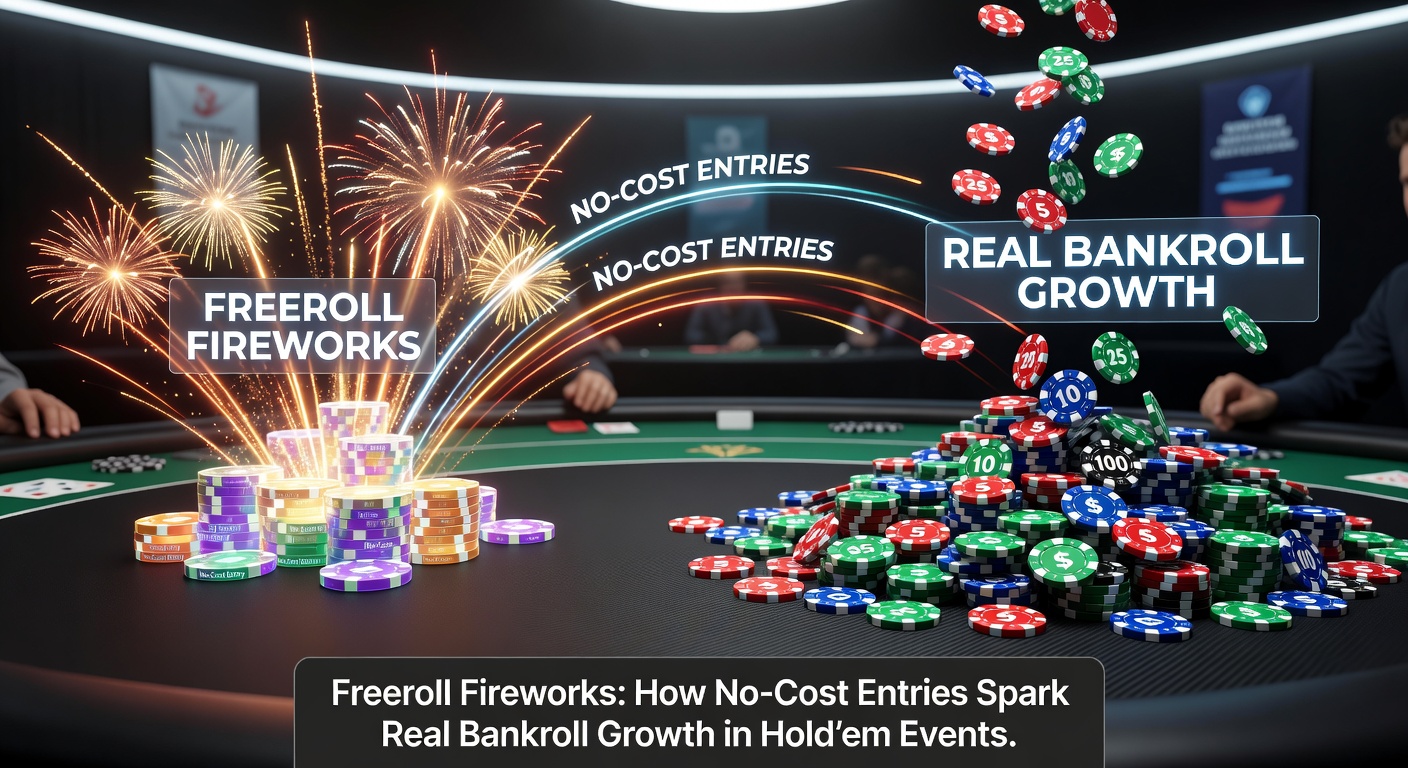
So players ladder up: freerolls feed Step 1 satellites, those unlock Steps 2-3, ultimately granting main event access; the math checks out because freeroll ROI, though low per event (around 5-10%), compounds via reinvestment, turning $0 starts into $1,000 bankrolls in 3-6 months for top grinders. People who've tracked this note how variance smooths over volume, with 50 freerolls yielding 5-7 cashes worth $200 total on average.
Strategies That Top Performers Deploy
Grinders adopt tight-aggressive play early, limping rarely while raising premium hands like AK, QQ+ from late position; as blinds rise, they shift to push-fold charts from tools like ICMIZER, shoving 15-20BB stacks with 40% equity ranges. But here's where it gets interesting: position trumps all, with button steals comprising 30% of winning hands per tournament analyzer data, because blinds post constantly in massive fields.
Those who've mastered freerolls multitask across tabs, entering passworded qualifiers for smaller fields (under 1,000 runners) that boast better odds; they log sessions, reviewing hands via trackers like Hold'em Manager to plug leaks, and results show improved ITM rates from 8% to 15% after 1,000 hands reviewed. Yet variance bites—streaks of 20 bad beats happen, so bankroll rules like 20-buy-in minimums keep players solvent.
Real-World Case Studies Spotlighting Growth Trajectories
Take one anonymous grinder from Canada who, in 2024, final-tabled three 888poker freerolls within weeks, banking $450 total; that funded satellites into the Sunday Million, where a deep run netted $2,300, per his shared tracker stats—now his roll sits at $15K after a year. Another example emerges from Australia, where a recreational player hit a $5K freeroll first on PartyPoker, rolled it into WPT seats, and cashed twice for $12K aggregate, as detailed in regional forums.
And consider European circuits: a Malta-based player parlayed daily freerolls into a $50K WSOP online seat via steps, finishing 47th for $8,200; reports from the Malta Gaming Authority highlight how such paths align with responsible gaming metrics, showing low-risk progression. These stories repeat globally, with forums buzzing over similar ladders.
The April 2026 Freeroll Surge
Now, as April 2026 unfolds, freeroll calendars explode with spring series—PokerStars launches $100K weekly pools through mid-month, while 888poker ramps passworded events for US players under new regulations; partypoker counters with $250K freerolls tied to Aussie Millions feeders, drawing 20K+ entries nightly. Observers point to blockchain-integrated sites offering crypto prizes, boosting appeal amid rising adoption, and data projects $5M+ total freeroll payouts platform-wide this month alone.
What's significant centers on hybrid formats: Hold'em freerolls blending with PLO variants, where skilled adapters snag larger shares; Canadian platforms like PlayNow expand access post-provincial legalization, hosting $50K events that feed national championships. This timing proves ideal for newcomers, as tax seasons wrap and disposable time peaks.
Navigating Risks in the Freeroll Arena
Although free, freerolls tempt overplay from masses, inflating variance; tilt ruins sessions, with 40% of entrants quitting mid-event per behavioral studies, so cooldowns and session limits prove essential. Platforms enforce age verification and deposit caps pre-withdrawal, aligning with regs like those from Australia's ACMA, ensuring payouts flow smoothly.
Bankroll mismanagement stalls growth—reinvesting 100% risks wipeouts, whereas 50/50 splits to play and savings sustain momentum; health trackers integrated in apps now flag multi-hour grinds, promoting breaks that maintain edge.
Conclusion
Freerolls ignite Hold'em bankrolls through accessible, prize-laden entry points that skilled players exploit via disciplined strategies and reinvestment; case studies and April 2026 schedules underscore ongoing potential, while regulatory oversight keeps paths viable. Data consistently shows zero-cost starts evolving into substantial rolls for those who grind smart, proving the fireworks aren't just hype—they deliver tangible growth in the poker ecosystem.